Top 20 Microservices Questions for Experienced Developers
1. What are the main advantages of a microservices architecture?
Business Use Case: “We are re-architecting our monolithic claims processing system, which is difficult to update and scale. Why should we consider microservices?”
Answer: Microservices offer several key advantages for a complex system like claims processing:
- Improved Scalability: We can scale individual services independently. For example, during month-end, we can scale just the
ClaimAdjudicationServicewithout having to scale the entire application. - Fault Isolation: If the
MemberEnrollmentServicehas a bug and crashes, it won’t take down the criticalClaimProcessingService. This improves the overall resilience of the system. - Independent Deployment: Teams can deploy their services independently. The team working on the
ProviderServicecan release updates multiple times a day without coordinating with theClaimServiceteam, leading to faster delivery. - Technology Diversity: We can use the best technology for the job. The
ClaimServicemight be written in Java, while a new reporting service could use Python for its data science libraries.
2. How do microservices communicate with each other?
Business Use Case: “Our new ClaimService needs to get data from the MemberService. Should this be a direct API call or should we use a message queue?”
Answer: There are two main patterns:
- Synchronous Communication (e.g., REST API): This is a direct request/response model. The
ClaimServicewould make an HTTP call to theMemberServiceand wait for a response. This is simple and good for real-time data lookups, like checking member eligibility. - Asynchronous Communication (e.g., Message Queue like Kafka): The
ClaimServicewould publish an event (likeClaimSubmitted) to a queue, and other services can subscribe to this event. This decouples the services and is great for workflows where an immediate response isn’t needed, like notifying a downstream reporting service.
3. What is service discovery and why is it important in microservices?
Business Use Case: “When we deploy a new version of the EligibilityService, its IP address might change. How do other services find it without us manually updating configuration files?”
Answer: This is solved by a Service Registry (like Eureka or Consul). Each microservice, upon startup, registers itself with the service registry and reports its IP address. When another service wants to call it, it first asks the registry for the current location of the EligibilityService. This allows for dynamic scaling and deployments without hard-coding addresses.
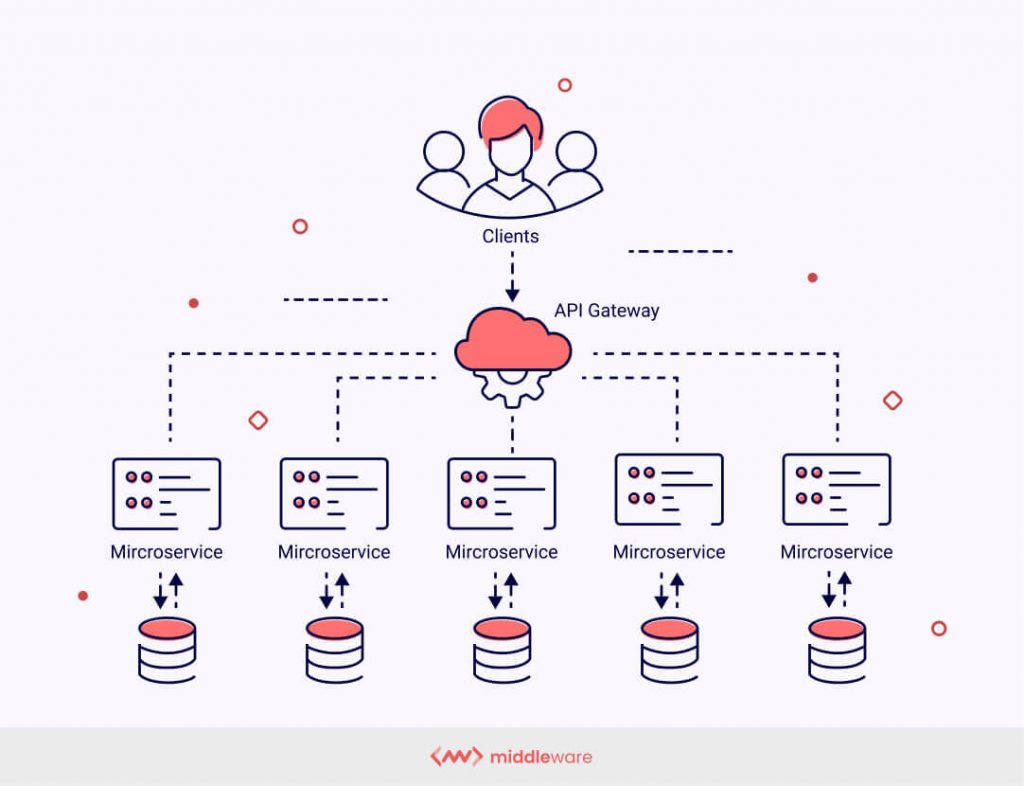
4. What is an API Gateway and why is it useful?
Business Use Case: “Our frontend application needs to call multiple services (Member, Claim, Provider) to build a single page. How can we simplify this and centralize security checks?”
Answer: An API Gateway acts as a single entry point for all client requests. It simplifies the system by:
- Routing: It routes incoming requests to the appropriate backend microservice.
- Aggregation: It can combine results from multiple services into a single response for the client.
- Centralizing Cross-Cutting Concerns: It’s the perfect place to handle authentication, rate limiting, and logging, so this logic doesn’t have to be duplicated in every single microservice.
5. How can you ensure data consistency in a distributed microservices environment?
Business Use Case: “When a claim is approved, we need to update the claim status in the ClaimService and trigger a payment in the PaymentService. How do we manage this transaction across two different services and databases?”
Answer: Since we can’t use a traditional ACID transaction across multiple databases, we rely on patterns that lead to eventual consistency. The most common pattern for this is the Saga Pattern.
6. What is the Saga Pattern?
Business Use Case: “For a complex member enrollment process that involves creating a member record, setting up their plan (PBO), and notifying the welcome-kit service, how would you use the Saga pattern to ensure it either completes fully or is properly rolled back?”
Answer: A Saga is a sequence of local transactions. If any step fails, the Saga executes compensating transactions to undo the work done in the previous steps. For the enrollment process, it would look like this:
MemberServicecreates the member (local transaction 1).- It then publishes a
MemberCreatedevent. PlanServiceconsumes this event and assigns the PBO (local transaction 2).- If the
PlanServicefails, it publishes aPlanAssignmentFailedevent. - The
MemberServicelistens for this and runs a compensating transaction to deactivate or delete the member, ensuring the system remains in a consistent state.
7. What is the Circuit Breaker pattern?
Business Use Case: “Our ClaimAdjudicationService calls an external, third-party API to check for fraudulent activity. If this external API is slow or down, how do we prevent our entire adjudication process from stalling?”
Answer: I would use the Circuit Breaker pattern (e.g., with Resilience4j). It wraps the external API call.
- If the external API starts failing, the circuit “opens,” and all subsequent calls fail immediately without even making a network request.
- This allows my service to execute a fallback logic, like approving the claim with a note for later review, instead of getting stuck.
- After a timeout, the circuit goes into a “half-open” state to see if the external service has recovered.
8. How do you handle authentication and authorization in microservices?
Business Use Case: “How do we ensure that a member can only view their own claims, while a provider can view claims for all patients under their care?”
Answer: This is typically handled by a central Identity Provider and an API Gateway.
- Authentication: The user authenticates with the Identity Provider (using OAuth 2.0) and gets a JWT (JSON Web Token).
- This JWT is passed in the header of every API request.
- Authorization: The API Gateway validates the JWT. The token contains the user’s ID and their roles (e.g., ‘MEMBER’, ‘PROVIDER’). The downstream microservices can then use this information to enforce business rules, like checking if the
memberIdin the token matches thememberIdon the claim being requested.
9. What is the purpose of a centralized configuration server?
Business Use Case: “We have multiple microservices (ClaimService, MemberService, PaymentService) that all need to connect to the same database and message queue. How do we manage these connection strings without duplicating them in every service’s configuration?”
Answer: We use a Config Server (like Spring Cloud Config). All shared configuration properties are stored in a central Git repository. When the microservices start up, they connect to the Config Server to fetch their properties. This allows us to change a database password in one place and have all services pick up the change without needing to be rebuilt and redeployed.
10. How does Spring Boot simplify microservice development?
Business Use Case: “As a team lead, why would you choose Spring Boot to build our new set of insurance microservices?”
Answer: Spring Boot is ideal for microservices because it’s built on the principle of “convention over configuration.” It provides:
- Auto-configuration: It automatically configures beans based on the JARs on the classpath, drastically reducing boilerplate code.
- Starter POMs: Simplifies dependency management. Including
spring-boot-starter-webgives you a web server and everything needed for a REST API. - Embedded Servers: It includes an embedded Tomcat or Netty, so we can run the service as a simple executable JAR file, which is perfect for containerization.
11. What is the role of containerization (Docker) and orchestration (Kubernetes)?
Business Use Case: “Once our ClaimService is built, how do we package and deploy it in a way that is scalable, resilient, and consistent across development and production environments?”
Answer:
- Docker (Containerization): We package the service (the Spring Boot JAR and its JRE) into a lightweight, portable container image. This ensures it runs the same way everywhere.
- Kubernetes (Orchestration): We use Kubernetes to manage these containers in production. It handles deploying new versions, scaling the number of instances up or down based on load, and automatically restarting a container if it crashes.
12. How do you implement distributed tracing?
Business Use Case: “A user reports that submitting a claim is taking over 10 seconds. The request goes through three different services. How do you pinpoint which service is the bottleneck?”
Answer: This is solved with Distributed Tracing using tools like Zipkin or Jaeger. A unique traceId is generated at the start of the request and is passed along to every microservice that gets called. Each service logs how long it took to do its part. The tracing tool then visualizes the entire request as a single trace, showing a timeline of which service took how long, making it easy to spot the bottleneck.
13. What is event-driven architecture?
Business Use Case: “When a claim is finalized, we need to notify the reporting service, the EOB generation service, and the audit service. How can we do this without the ClaimService needing to know about all these downstream systems?”
Answer: We can use an Event-Driven Architecture. Instead of calling each service directly, the ClaimService simply publishes a ClaimFinalized event to a message broker like Kafka. The other services subscribe to this event and react to it independently. This decouples the services; we can add a new subscriber later without ever changing the ClaimService.
14. How do you handle testing in a microservices architecture?
Business Use Case: “How would you test the ClaimSubmission flow, which involves calls from the ClaimService to the MemberService and ProviderService?”
Answer: Testing becomes multi-layered:
- Unit Tests: Still essential for testing the business logic within each service in isolation, mocking any external calls.
- Integration Tests: These test the service’s interaction with its own database or other infrastructure.
- Contract Tests: We use tools like Spring Cloud Contract to define a “contract” for how services communicate. This ensures that a change in the
MemberServiceAPI doesn’t break theClaimServicewithout us knowing. - End-to-End Tests: These are run in a full, deployed environment to test the entire user flow. They are valuable but slow and brittle, so we use them sparingly.
15. What is idempotency and why is it important?
Business Use Case: “A provider’s system automatically retries a claim submission if it gets a network error. How do we prevent a duplicate claim from being created in our system?”
Answer: We make the API idempotent. This means the same request can be made multiple times with the same outcome as making it once. The best way to do this is to require the client to send a unique Idempotency-Key in the request header. The first time the server sees this key, it processes the claim. If it sees the same key again, it knows it’s a retry and simply returns the original success response without creating a duplicate claim.
16. What is the database-per-service pattern?
Business Use Case: “Why should our MemberService and ClaimService have their own separate databases instead of sharing one large database?”
Answer: The database-per-service pattern is a core principle of microservices. It ensures that services are truly independent. If both services shared a database, a schema change required by the ClaimService could accidentally break the MemberService. By giving each service its own database, teams can manage their data and schema independently, avoiding conflicts and enabling true autonomy.
17. How do you implement versioning in microservices?
Business Use Case: “We need to add a new mandatory field to our ClaimSubmission API. How can we roll this out without breaking all the existing client applications that use the old format?”
Answer: This requires API versioning. A common and clear approach is URI versioning. We would introduce a new endpoint, /api/v2/claims, which enforces the new contract. The old endpoint, /api/v1/claims, would be maintained for backward compatibility. This allows clients to migrate to the new version at their own pace.
18. What are health checks and why are they important?
Business Use Case: “How does our load balancer know if an instance of the EligibilityService has crashed or frozen, so it can stop sending traffic to it?”
Answer: Each microservice exposes a health check endpoint (e.g., /actuator/health in Spring Boot). The load balancer or container orchestrator (like Kubernetes) periodically calls this endpoint. If the service returns a 200 OK status, it’s considered healthy. If it fails to respond or returns an error, it’s marked as unhealthy, and traffic is automatically routed away from it.
19. What is the role of a message broker (like Kafka)?
Business Use Case: “When would you use Kafka to communicate between the ClaimService and the NotificationService instead of a direct REST API call?”
Answer: I would use a message broker like Kafka for asynchronous communication. This is ideal when:
- Decoupling is needed: The
ClaimServicedoesn’t need to know if theNotificationServiceis up or down. It just fires an event and moves on. - Durability is important: If the
NotificationServiceis down, the message stays in Kafka until the service comes back online, so no notifications are lost. - Multiple consumers exist: The same
ClaimFinalizedevent can be consumed by the notification service, a reporting service, and an audit service simultaneously.
20. How do you handle long-running processes?
Business Use Case: “A user requests a year-end summary report of all their claims, which can take several minutes to generate. How do you design the API so the user’s browser doesn’t time out waiting for a response?”
Answer: For long-running tasks, I would use an asynchronous approach. The controller would immediately return a 202 Accepted response with a link to a status endpoint. The report generation task would be pushed to a message queue (like Kafka or RabbitMQ) and processed by a separate worker service. The client can then poll the status endpoint to check when the report is ready for download.
21. Explain the difference between Monolithic and Microservices architecture. When would you choose one over the other in an insurance context?
Business Use Case: “We are building a new insurance application. Should we build it as a single, large application (a monolith) or as a set of smaller, independent services (microservices)? What are the trade-offs?”
Answer: “This is a critical architectural decision that depends heavily on the scale and complexity of the application. Both architectures have their place.
Monolithic Architecture
A monolith is a traditional approach where the entire application—UI, business logic for claims, members, billing, and data access—is built and deployed as a single, unified unit.
- Insurance Example: A simple, internal application for managing a single, niche insurance product like event cancellation insurance. All logic is in one codebase, connected to one database.
- Pros:
- Simpler to Develop & Deploy: Initially, it’s faster to build and easier to deploy since it’s just one application.
- No Network Latency: All components run in the same process, so communication is fast.
- Cons:
- Hard to Scale: You must scale the entire application, even if only one part (like claims processing) is under heavy load.
- Low Fault Tolerance: A bug in a non-critical module (like report generation) can crash the entire application, stopping critical processes like claim submissions.
- Technology Lock-in: The entire application is built with a single technology stack.
Microservices Architecture
In a microservices architecture, the application is broken down into a collection of small, independent services, each responsible for a specific business domain.
- Insurance Example: A large, enterprise-wide insurance platform. You would have separate services for
ClaimService,MemberService,BillingService, andPaymentService. Each service has its own database and can be deployed independently. - Pros:
- Independent Scalability: You can scale only the services that need it. For example, scale the
ClaimServiceduring peak processing times without touching theBillingService. - High Fault Tolerance: If the
BillingServicefails, members can still submit claims because theClaimServiceis running independently. This is crucial for high-availability systems. - Independent Deployment & Agility: The claims team can deploy updates to their service multiple times a day without coordinating with the member team, leading to faster feature delivery.
- Independent Scalability: You can scale only the services that need it. For example, scale the
- Cons:
- Operational Complexity: It’s much more complex to manage, requiring solutions for service discovery, distributed transactions (Saga pattern), centralized logging, and monitoring.
- Network Latency: Services communicate over the network, which introduces latency.
When to Choose Which:
- Choose a Monolith for: Small projects, startups, or prototypes where speed of initial development is the top priority and the team is small.
- Choose Microservices for: Large, complex, enterprise-level applications that need to be highly scalable, available, and will be maintained by multiple independent teams over a long period. For a comprehensive insurance platform, a microservices architecture is almost always the correct long-term choice.”
Comments