Top 10 Java Design Patterns for Senior Developers
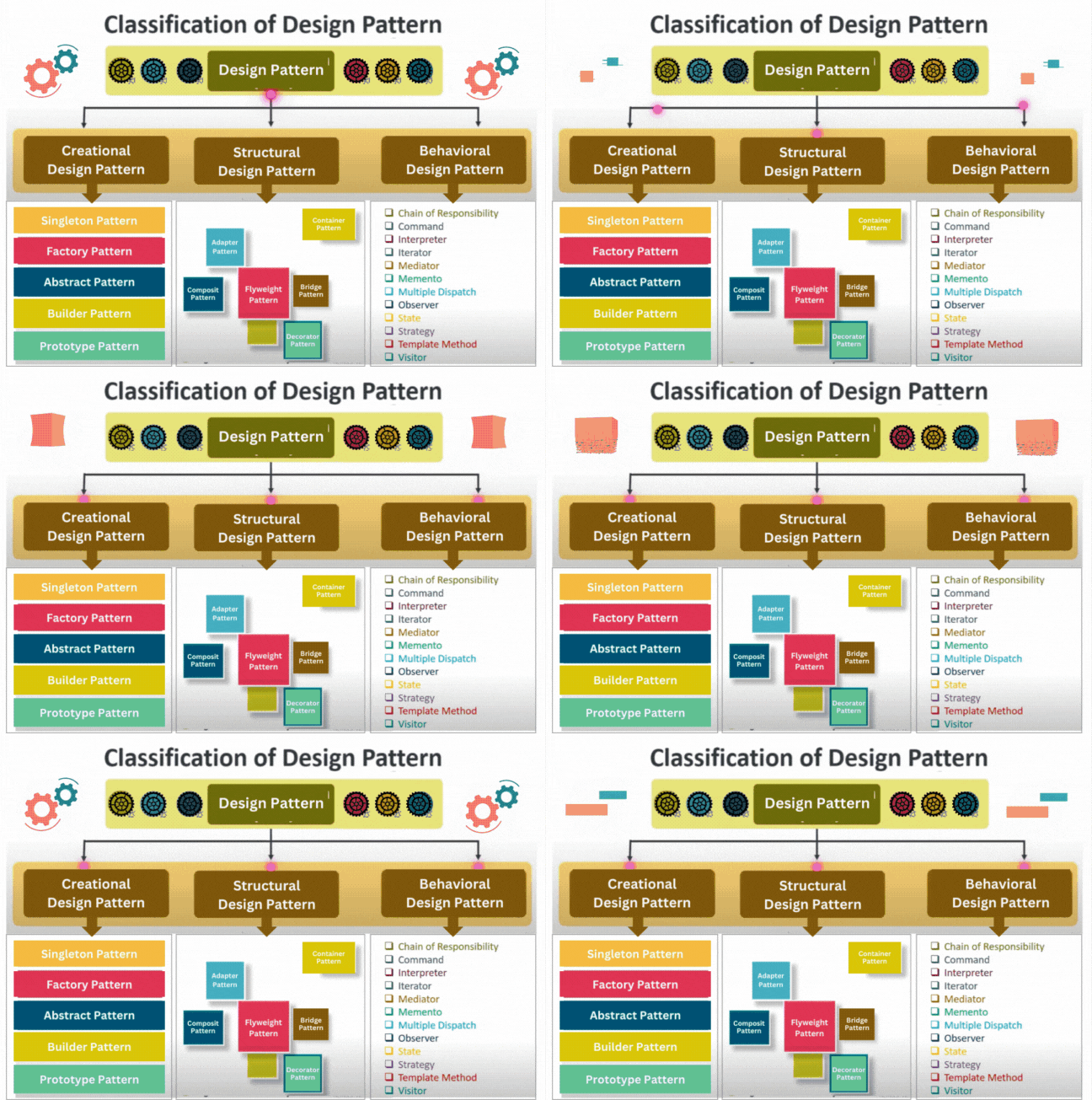
Design patterns are reusable, proven solutions to commonly occurring problems within a given context in software design. For senior developers, a deep understanding of these patterns is crucial for building scalable, maintainable, and flexible applications.
Creational Patterns
Creational patterns provide various object creation mechanisms, which increase flexibility and reuse of existing code.
1. Singleton Pattern
Intent: Ensures a class has only one instance and provides a global point of access to it.
Business Use Case: “Our application needs a single, globally accessible object to manage application-level configuration that is loaded once at startup. We must ensure no more than one instance of this configuration manager is ever created.”
Implementation: The modern, recommended way to implement a thread-safe Singleton in Java is using an enum. It’s concise and handles serialization and thread-safety issues automatically.
/**
 * Enum-based Singleton is the most robust way to implement this pattern.
 * It handles thread-safety and serialization issues out of the box.
 */
public enum ConfigurationManager {
    INSTANCE; // The single, globally accessible instance

    private String databaseUrl;

    // The constructor is implicitly private
    private ConfigurationManager() {
        // Load configuration from a file or other source
        this.databaseUrl = "jdbc:postgresql://prod.db.server:5432/claims_db";
        System.out.println("ConfigurationManager initialized.");
    }

    public String getDatabaseUrl() {
        return databaseUrl;
    }
}
2. Factory Method Pattern
Intent: Defines an interface for creating an object but lets subclasses decide which class to instantiate.
Business Use Case: “Our application needs to create different types of Claim objects (MedicalClaim, DentalClaim, VisionClaim) based on an input string. We want to avoid a large if-else block in our service class.”
Implementation: A factory encapsulates the creation logic, decoupling the client (the service) from the concrete classes.
public interface Claim {
    void process();
}

public class MedicalClaim implements Claim {
    public void process() { System.out.println("Processing Medical Claim..."); }
}

public class DentalClaim implements Claim {
    public void process() { System.out.println("Processing Dental Claim..."); }
}

public class ClaimFactory {
    public static Claim createClaim(String claimType) {
        if ("MEDICAL".equalsIgnoreCase(claimType)) {
            return new MedicalClaim();
        } else if ("DENTAL".equalsIgnoreCase(claimType)) {
            return new DentalClaim();
        }
        throw new IllegalArgumentException("Unknown claim type: " + claimType);
    }
}

// Client code
// Claim medicalClaim = ClaimFactory.createClaim("MEDICAL");
// medicalClaim.process();
3. Builder Pattern
Intent: Separates the construction of a complex object from its representation, so that the same construction process can create different representations.
Business Use Case: “We need to create a Policy object that has many optional configuration parameters, like deductible, copay, outOfPocketMax, and isPpoPlan. We want to avoid a constructor with a long list of parameters (a ’telescoping constructor’).”
Implementation: The Builder pattern provides a fluent API for constructing objects step-by-step, improving readability.
public class Policy {
    private final String policyId; // required
    private final String memberId; // required
    private final double deductible; // optional
    private final double copay;      // optional

    private Policy(Builder builder) {
        this.policyId = builder.policyId;
        this.memberId = builder.memberId;
        this.deductible = builder.deductible;
        this.copay = builder.copay;
    }

    // Static nested Builder class
    public static class Builder {
        private final String policyId;
        private final String memberId;
        private double deductible = 0.0;
        private double copay = 0.0;

        public Builder(String policyId, String memberId) {
            this.policyId = policyId;
            this.memberId = memberId;
        }

        public Builder withDeductible(double deductible) {
            this.deductible = deductible;
            return this; // Return builder for chaining
        }

        public Builder withCopay(double copay) {
            this.copay = copay;
            return this;
        }

        public Policy build() {
            return new Policy(this);
        }
    }
}

// Client code
// Policy policy = new Policy.Builder("POL123", "MEM456")
//                         .withDeductible(1000.0)
//                         .withCopay(25.0)
//                         .build();
Structural Patterns
Structural patterns explain how to assemble objects and classes into larger structures while keeping these structures flexible and efficient.
4. Adapter Pattern
Intent: Allows objects with incompatible interfaces to collaborate.
Business Use Case: “Our system uses a standard IProviderValidator interface. We need to integrate with a new, third-party validation service that has a completely different API (e.g., its method is named verifyProvider(String npi) instead of isValid(Provider provider)). We don’t want to change our existing code.”
Implementation: The Adapter acts as a bridge between our interface and the third-party service’s interface.
// Our existing interface
public interface IProviderValidator {
    boolean isValid(String providerId);
}

// The third-party service we can't change
public class ExternalProviderVerifier {
    public boolean check(String npi) {
        // ... logic to verify provider
        return true;
    }
}

// The Adapter class
public class ProviderVerifierAdapter implements IProviderValidator {
    private final ExternalProviderVerifier externalVerifier = new ExternalProviderVerifier();

    @Override
    public boolean isValid(String providerId) {
        // Adapts our method call to the external service's method call
        return externalVerifier.check(providerId);
    }
}
5. Decorator Pattern
Intent: Attaches new behaviors to objects by placing them inside special wrapper objects that contain the behaviors.
Business Use Case: “We have a base Policy object. We want to dynamically add optional coverages like ‘Dental Coverage’ or ‘Vision Coverage’ at runtime. Each added coverage modifies the final premium calculation.”
Implementation: Decorators wrap the base object, adding new functionality while maintaining the same interface.
public interface Policy {
    double getPremium();
}

public class BasicHealthPolicy implements Policy {
    @Override
    public double getPremium() {
        return 500.0;
    }
}

// Abstract Decorator
public abstract class PolicyDecorator implements Policy {
    protected Policy decoratedPolicy;

    public PolicyDecorator(Policy decoratedPolicy) {
        this.decoratedPolicy = decoratedPolicy;
    }

    public double getPremium() {
        return decoratedPolicy.getPremium();
    }
}

// Concrete Decorator
public class DentalCoverageDecorator extends PolicyDecorator {
    public DentalCoverageDecorator(Policy decoratedPolicy) {
        super(decoratedPolicy);
    }

    @Override
    public double getPremium() {
        return super.getPremium() + 75.0; // Add cost of dental coverage
    }
}

// Client code
// Policy myPolicy = new BasicHealthPolicy();
// myPolicy = new DentalCoverageDecorator(myPolicy); // Wrap it
// System.out.println("Total Premium: " + myPolicy.getPremium()); // Outputs 575.0
6. Facade Pattern
Intent: Provides a simplified, unified interface to a complex subsystem of classes.
Business Use Case: “Submitting a new claim is a complex process that involves multiple services: MemberService (to check eligibility), ProviderService (to validate the provider), and AdjudicationService (to process the claim). We want to provide a single, simple method for clients to submit a claim without needing to know about all these internal services.”
Implementation: The Facade hides the complexity of the subsystem behind a simple interface.
// Complex Subsystem
class MemberService { public boolean isEligible(String memberId) { return true; } }
class ProviderService { public boolean isValid(String providerId) { return true; } }
class AdjudicationService { public void adjudicate(Claim claim) { /* ... */ } }

// The Facade
public class ClaimSubmissionFacade {
    private MemberService memberService = new MemberService();
    private ProviderService providerService = new ProviderService();
    private AdjudicationService adjudicationService = new AdjudicationService();

    public void submitClaim(Claim claim) {
        if (memberService.isEligible(claim.getMemberId()) && providerService.isValid(claim.getProviderId())) {
            adjudicationService.adjudicate(claim);
            System.out.println("Claim submitted successfully.");
        } else {
            System.out.println("Claim submission failed validation.");
        }
    }
}
8. Proxy Pattern
Intent: Provide a surrogate or placeholder for another object to control access to it.
Business Use Case: “We have a Claim object that contains a large list of historical notes, which are expensive to load from the database. We only want to load these notes when a user actually clicks on the ‘View Notes’ button. How can we implement this lazy loading?”
Implementation: A ClaimProxy can be used. The client interacts with the proxy, which has the same interface as the real Claim object. The proxy only loads the expensive notes when the getNotes() method is called for the first time.
public interface IClaim {
    String getId();
    List<String> getNotes();
}

// The real, heavy object
public class RealClaim implements IClaim {
    private String id;
    private List<String> notes;

    public RealClaim(String id) {
        this.id = id;
        loadNotesFromDatabase(); // Expensive operation
    }

    private void loadNotesFromDatabase() {
        System.out.println("Fetching notes for claim " + id + " from DB...");
        this.notes = Arrays.asList("Note 1", "Note 2");
    }

    @Override
    public String getId() { return id; }
    @Override
    public List<String> getNotes() { return notes; }
}

// The Proxy object
public class ClaimProxy implements IClaim {
    private String id;
    private RealClaim realClaim; // The proxy holds a reference to the real object

    public ClaimProxy(String id) { this.id = id; }

    @Override
    public String getId() { return id; }

    @Override
    public List<String> getNotes() {
        if (realClaim == null) { // Lazy initialization
            this.realClaim = new RealClaim(this.id);
        }
        return realClaim.getNotes();
    }
}
Behavioral Patterns
Behavioral patterns are concerned with algorithms and the assignment of responsibilities between objects.
9. Strategy Pattern
Intent: Defines a family of algorithms, encapsulates each one, and makes them interchangeable.
Business Use Case: “Our application needs to support multiple payment calculation methods for claims (e.g., PPOPaymentStrategy, HMOOaymentStrategy), each with different logic. We want to select the correct strategy at runtime based on the member’s plan.”
Implementation: This allows the ClaimProcessor to use a payment strategy without being coupled to its specific implementation.
public interface PaymentCalculationStrategy {
    double calculate(Claim claim);
}

public class PpoPaymentStrategy implements PaymentCalculationStrategy {
    public double calculate(Claim claim) { return claim.getBilledAmount() * 0.8; } // 80% coverage
}

public class HmoPaymentStrategy implements PaymentCalculationStrategy {
    public double calculate(Claim claim) { return claim.getBilledAmount() * 0.9; } // 90% coverage
}

public class ClaimProcessor {
    private PaymentCalculationStrategy strategy;

    public void setStrategy(PaymentCalculationStrategy strategy) {
        this.strategy = strategy;
    }

    public double processPayment(Claim claim) {
        return strategy.calculate(claim);
    }
}
8. Observer Pattern
Intent: Defines a one-to-many dependency between objects so that when one object (the subject) changes state, all its dependents (observers) are notified and updated automatically.
Business Use Case: “When a claim’s status changes to ‘Approved’, we need to notify multiple downstream systems: the PaymentService, the NotificationService (to email the member), and an AuditService. We want to do this without tightly coupling the Claim service to all these other services.”
Implementation: The Claim object is the “Subject”. The other services are “Observers” that register to receive updates.
import java.util.ArrayList;
import java.util.List;

// Observer interface
interface ClaimObserver {
    void update(Claim claim);
}

// Subject
class Claim {
    private List<ClaimObserver> observers = new ArrayList<>();
    private String status;

    public void addObserver(ClaimObserver observer) {
        observers.add(observer);
    }

    public void setStatus(String status) {
        this.status = status;
        notifyObservers();
    }

    private void notifyObservers() {
        for (ClaimObserver observer : observers) {
            observer.update(this);
        }
    }
}

// Concrete Observer
class AuditService implements ClaimObserver {
    @Override
    public void update(Claim claim) {
        System.out.println("AUDIT: Claim status changed to " + claim.status);
    }
}
11. Template Method Pattern
Intent: Defines the skeleton of an algorithm in a base class but lets subclasses override specific steps of the algorithm without changing its structure.
Business Use Case: “All claim processing follows the same high-level steps: 1) Validate, 2) Price, 3) Apply Benefits. However, the specific implementation of each step is different for DentalClaim and MedicalClaim. We want to enforce this workflow while allowing for specific implementations.”
Implementation: An abstract base class defines the template method (processClaim), and abstract methods for the steps that subclasses must implement.
public abstract class ClaimProcessorTemplate {
    // The template method - final to prevent overriding
    public final void processClaim(Claim claim) {
        validate(claim);
        price(claim);
        applyBenefits(claim);
        System.out.println("Claim processing complete.");
    }

    // Steps to be implemented by subclasses
    protected abstract void validate(Claim claim);
    protected abstract void price(Claim claim);
    protected abstract void applyBenefits(Claim claim);
}

public class DentalClaimProcessor extends ClaimProcessorTemplate {
    @Override
    protected void validate(Claim claim) { System.out.println("Validating dental-specific rules..."); }
    @Override
    protected void price(Claim claim) { System.out.println("Pricing using dental fee schedule..."); }
    @Override
    protected void applyBenefits(Claim claim) { System.out.println("Applying dental plan benefits..."); }
}
10. State Pattern
Intent: Allows an object to alter its behavior when its internal state changes. The object will appear to change its class.
Business Use Case: “A Claim object can be in various states: Submitted, Pending, Approved, Denied. The actions you can perform on a claim depend on its current state. For example, you can only ‘approve’ a ‘pending’ claim, not a ‘submitted’ one. We want to avoid a massive if/else block in the Claim class.”
Implementation: We create separate classes for each state, and the Claim object delegates its behavior to its current state object.
interface ClaimState {
    void approve(ClaimContext context);
    void deny(ClaimContext context);
}

class SubmittedState implements ClaimState {
    public void approve(ClaimContext c) { System.out.println("Cannot approve a submitted claim. Must be pending first."); }
    public void deny(ClaimContext c) { System.out.println("Cannot deny a submitted claim. Must be pending first."); }
}

class PendingState implements ClaimState {
    public void approve(ClaimContext c) {
        System.out.println("Claim approved.");
        c.setState(new ApprovedState());
    }
    public void deny(ClaimContext c) {
        System.out.println("Claim denied.");
        c.setState(new DeniedState());
    }
}

class ApprovedState implements ClaimState { /* ... */ }
class DeniedState implements ClaimState { /* ... */ }

// The Context class
class ClaimContext {
    private ClaimState state;

    public ClaimContext() {
        this.state = new SubmittedState(); // Initial state
    }

    public void setState(ClaimState state) { this.state = state; }
    public void approve() { state.approve(this); }
    public void deny() { state.deny(this); }
}

Comments